
Every organization has a decision rights system. The question is whether it was designed or absorbed.
1. Implied authority carries a carrying cost
When decision rights are absorbed rather than designed, the pattern is recognizable. A material exception waits in an inbox because no one is certain whether it is a business decision, a legal decision, or a board decision. A contract term, a vendor issue, or a customer accommodation travels laterally between functions until someone senior volunteers. A matter that should have been resolved at manager level arrives at the General Counsel's desk because the threshold was never written down.
None of that appears on a risk register. It appears as cycle time, duplicated review, delayed remediation, and executive attention spent on questions the organization has already answered somewhere else.
The cost is not merely slower decisions. It is inconsistent ones. Two similar matters reach different outcomes because they were routed to different people under different assumptions. That inconsistency is difficult to defend when a regulator, an auditor, or a board asks how the organization exercises judgment.
A policy is not an operating model.
2. Escalation is a threshold, not a sentiment
"Escalate when appropriate" is not an instruction. It is a transfer of risk to whoever happens to be holding the matter.
A workable escalation standard states four things without ambiguity:
- Trigger — the condition, value band, category, or severity that requires escalation
- Owner — the role accountable for the decision at that level
- Timeline — the interval within which the decision must be recorded
- Path — where the matter goes if the owner does not act
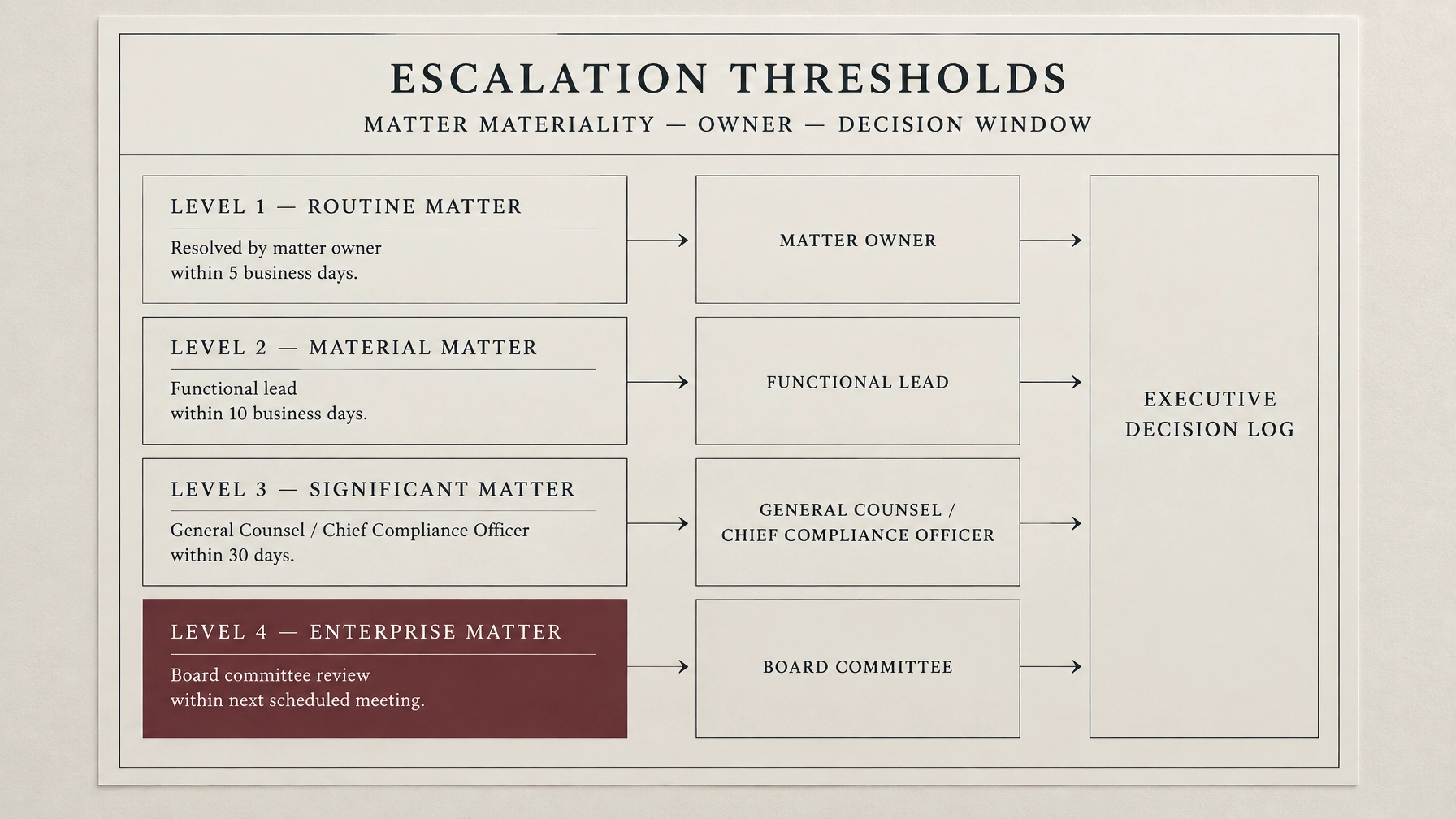
Matter materiality, accountable owner, decision window
Thresholds should be specific enough to apply under pressure and simple enough to recall without a manual. Value bands, matter categories, regulatory exposure, cross-border reach, reputational consequence, and repeat occurrence are all legitimate triggers. What matters is that the organization chooses them deliberately rather than discovering them during the incident.
The IIA's Three Lines Model places accountability for risk and oversight with defined roles, and assigns the governing body responsibility for governance structures and risk appetite. That structure functions only when the decisions inside it are routable. Roles without thresholds produce committees, not decisions.
3. Exceptions are the signal, not the noise
Organizations tend to treat exceptions as irregular events to be closed. In practice, exceptions are the richest dataset most compliance and risk functions have.
An override tells you where the standard does not fit the work. A late escalation tells you where the threshold is unclear or the owner is unavailable. A recurring conflict tells you where two functions hold overlapping authority.
Recording exceptions consistently — who approved, under what authority, on what reasoning, for how long — converts scattered judgment calls into a pattern leaders can act on. That is the difference between an organization that resolves matters and one that improves how it decides.
Where exceptions cluster, the remedy is rarely a reminder. It is a change to ownership, thresholds, workflow, or the system the work runs through.
4. Documentation is the accountability mechanism
Accountability is not a tone of voice. It is a record.
A decision log that captures the matter, the decision, the authority relied on, the rationale, the date, and the owner creates continuity across personnel changes and executive turnover. It also shortens the distance between a question and an answer when the board, an auditor, or a regulator asks why the organization acted as it did.
This is not documentation for its own sake. It is the evidence layer that makes an escalation system auditable and a governance program defensible.
5. Build the routing into the stack you already run
Most organizations already own the tools. Intake exists. The case system exists. The reporting layer exists. What is missing is the connective tissue: the thresholds, the ownership map, the exception record, and the review cadence that turn separate tools into one operating path.
SignalAuthority™ is built for that layer. It defines decision rights by role and matter type, sets escalation thresholds and routing paths, records exceptions, conflicts, and overrides, and maintains an executive decision log on a fixed review cadence. It runs on top of systems already in place rather than replacing them.
Operational risk becomes manageable when it is converted into repeatable infrastructure — defined ownership, routable thresholds, recorded judgment, observed patterns — rather than handled matter by matter.
This content is general business and compliance information, not legal advice.