A director of risk operations leaves the company after three years. Six weeks into a successor's tenure, a regulator asks why the organization accepted a particular third-party arrangement, under whose authority the acceptance was made, and what conditions were attached. The answer lives somewhere between the departed leader's institutional memory, a departed leader's former inbox, and a slide deck from a meeting nobody can fully reconstruct. Every organization knows this scenario. Most still keep their decision history in the one place guaranteed to lose it: other people's heads.
The familiar version of a decision log is a dated list: what was decided and by whom. That version satisfies the meeting minutes instinct and fails the turnover test. A decision record earns its keep only when it captures the reasoning and the conditions around each call, so that a successor inherits context rather than a mystery. The International Organization for Standardization (ISO) 31000:2018 risk management guidelines state in clause 6.7 that the risk management process and its outcomes should be recorded and reported by suitable means to inform decisions, improve the process, and support interaction with stakeholders, including those accountable for risk. Recording, in other words, is not an administrative courtesy. It is what allows accountability to survive the person who held it.
1. What a decision log actually records
The durable version of a decision log contains more than outcomes. For each consequential decision, it holds the named role that made it, the specific information relied upon at the time, the conditions or limits attached, and the status of those conditions today. It is not a diary of activity. It is an operating record, structured so a reader who was not in the room can reconstruct the decision's basis without a briefing.
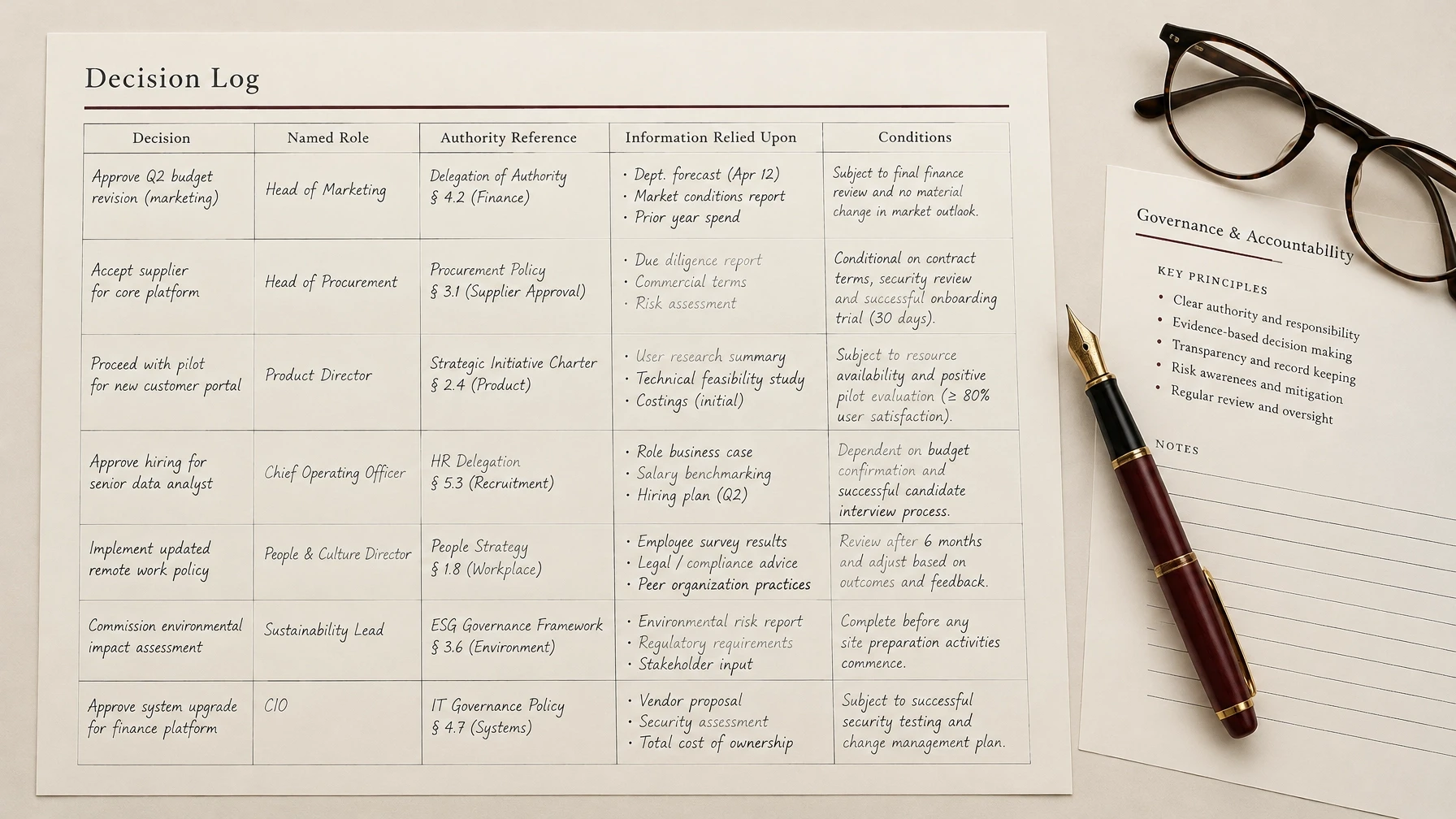
2. Turnover exposes what the record was actually for
Decision quality gets tested twice: once at the moment of the call, and again when a successor, auditor, or regulator revisits it without the original context. When the rationale lives only in a departed leader's explanation, the organization inherits the decision but not its basis. The new leader either relitigates it, which signals instability, or honors it blindly, which inherits unexamined risk. Neither behavior is a failure of the successor. It is a failure of the record.
This is also why the decision log matters most at the handoff, not the moment of the decision. Its value is measured by how little oral history is required to make it usable.
3. The conditions are the part that keeps paying
Most organizations record what was decided. Fewer record what the decision was conditional on. A conditional approval, a phased rollout, an assumption about market conditions, a threshold that held only at a particular risk level: these conditions carry their own lifecycle, and they are the first thing to go missing in a transition. When the condition expires silently, the decision's original basis quietly erodes while the decision itself appears to stand. A decision log that tracks conditions as live items, not footnotes, is what keeps a standing decision honest after the person who made it is gone.
4. Decision records are how audits actually start
In practice, an audit does not begin with a request for a compliance program. It begins with a request to see how a specific decision was made: which authority it came from, what information supported it, who approved it, and what documentation exists. An organization that can produce that record quickly demonstrates something a policy manual cannot: that decisions are made inside a system, not around one. The speed and completeness of the decision log is often the first signal an examiner receives about the maturity of the governance operation behind it.
5. Where the decision log lives
A decision log that lives in a document gets updated when someone remembers to. One that lives in the same operational systems as the decisions themselves gets updated because the workflow runs through it. For SignalLane, this is the difference between a static artifact and SignalAuthority™: decision rights, escalation routes, and the record of how each consequential call was made operate as one connected layer in the tools the organization already runs, rather than a parallel artifact waiting for someone to maintain it. The result is a decision record that does not depend on any single leader's habits.
For any material decision, a leadership team should be able to answer four questions without leaving the record: what was decided, under what authority, on what information, and with what conditions still open. When those answers live in a system rather than in people, turnover becomes a personnel event instead of an institutional memory event.
To put this into practice with SignalAuthority™, you can request an organizational license.
This content is general business and compliance information, not legal advice.